
By Elena Moreau, Immigration Policy Specialist · Updated June 8, 2026
Reviewed based on official IRCC announcements and canada.ca (updated May 2026)
Canada Express Entry is the federal government’s points-based system for selecting skilled workers for permanent residence. In 2026, IRCC has held 30 draws and issued 79,841 Invitations to Apply as of May 28.
CEC draw cutoffs have stayed between 507 and 518. French-language draws have run as low as 393.
This guide covers exactly how the CRS scoring works, which draw type suits your profile, what documents you need, and what the proposed 2026 reform means for candidates currently in the pool.
Quick Facts — Canada Express Entry 2026
| Total ITAs issued in 2026 | 79,841 (as of May 28) |
| Draws held in 2026 | 30 draws |
| Lowest CRS cutoff in 2026 | 391 (Physicians draw) |
| Highest CRS cutoff in 2026 | 518 (CEC draw, May 27) |
| Current pool size | ~238,847 profiles |
| Processing time after ITA | 6–7 months |
| PR application cost | CAD $1,590 per adult |
Calculate your CRS score free → | See all 2026 draw results →
What is Canada Express Entry and How Does It Work?
Express Entry is Canada’s primary online system for managing permanent residence applications from skilled foreign workers.
Immigration, Refugees and Citizenship Canada (IRCC) uses it to select candidates through a points-based competition called the Comprehensive Ranking System (CRS).
The system works like this: candidates create a profile and enter a pool if they meet basic eligibility requirements.
IRCC then holds draws every one to two weeks and issues Invitations to Apply to candidates at or above the cutoff CRS score. Those who receive an ITA have exactly 60 days to submit a complete permanent residence application.
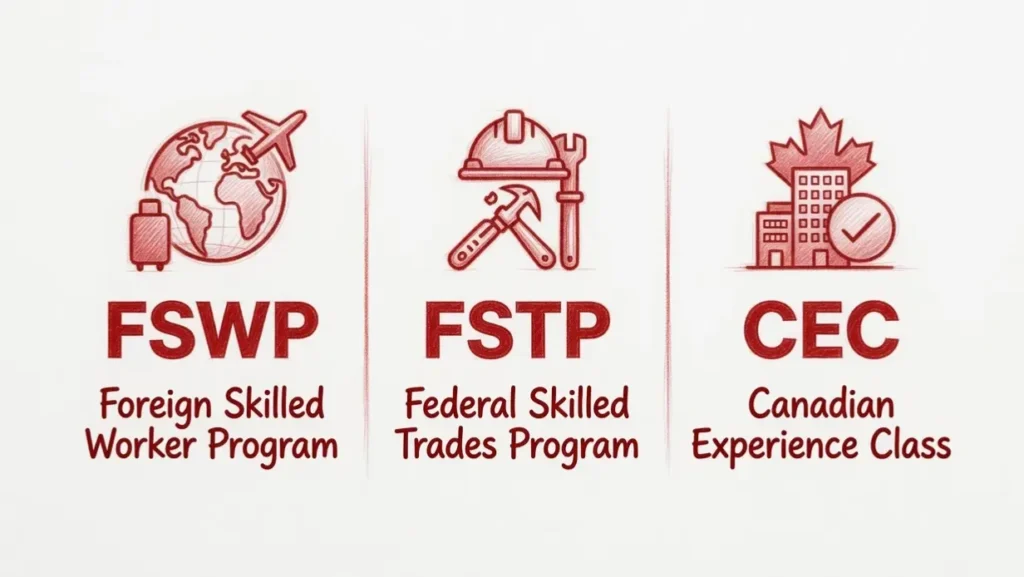
Three programs currently feed into the Express Entry pool: Federal Skilled Worker Program (FSWP), Canadian Experience Class (CEC), and Federal Skilled Trades Program (FSTP).
In 2026, IRCC has run draws almost exclusively for CEC candidates and category-based groups, general all-program draws have been rare. This matters because your program affects which draws you qualify for and what CRS score you need.
Source: IRCC Express Entry — How it works (canada.ca, updated May 2026)
Express Entry Programs: Which One Are You Eligible For?
Understanding which program applies to you is the first step in building your Express Entry strategy.
The three programs have different eligibility rules and have historically had different draw frequencies.
| Program | Who Qualifies | Key Requirement |
|---|---|---|
| Federal Skilled Worker (FSWP) | Foreign-educated skilled workers | 67 points on FSWP grid + CLB 7 language |
| Canadian Experience Class (CEC) | Workers with Canadian experience | 1 year Canadian skilled work + CLB 7 |
| Federal Skilled Trades (FSTP) | Trades workers | 2 years trades work + CLB 5 |
In 2026, CEC candidates have had the clearest path to an ITA because IRCC has prioritised draws for people already living and working in Canada.
If you have Canadian work experience, entering the pool under CEC gives you access to the most active draw stream of the year.
Full comparison — FSWP vs CEC vs FSTP: which program suits your profile?
Major Shift: The Proposed 2026 Express Entry Reform
IRCC has proposed the biggest structural change to Express Entry since the system launched in 2015. The plan is to retire all three existing programs: FSWP, CEC, FSTP and replace them with a single unified Federal High-Skilled Class.
What the New Single Class Means
The reform simplifies the system by removing the need for applicants to determine which specific program they qualify under. One set of eligibility rules would apply to everyone entering the pool.
Under the proposed changes, candidates would need at least one year of skilled work experience: in Canada or abroad and a minimum Canadian Language Benchmark level of 6 across all four abilities.
This standardisation treats foreign and Canadian work experience more equally, which is a significant shift from the current system where Canadian experience carries a much larger advantage.
What the Reform Means for Current Candidates
Public consultations on the reform ran through May 2026. Implementation is expected in late 2026 or 2027, no confirmed date has been announced by IRCC.
Current draws continue normally under existing rules until the change takes effect. Candidates already in the pool will not be removed when the new class launches.
If you are currently building your Express Entry profile, proceed under the existing system. The reform is not yet in effect and the timeline remains uncertain.
Core Eligibility Criteria for Entering the Express Entry Pool
To enter the Express Entry pool in 2026, candidates generally need to meet these requirements:
- At least one year of full-time skilled work experience in NOC TEER 0, 1, 2, or 3 occupations within the last 10 years or equivalent part-time hours
- Valid language test results showing CLB 6 or higher in all four abilities: reading, writing, listening, speaking.
- A Canadian secondary school credential, or a foreign credential assessed by an IRCC-approved Educational Credential Assessment organisation such as WES or IQAS
- Proof of sufficient settlement funds, unless exempt because of valid Canadian work experience or a valid employer job offer
- Police certificates, medical exam results, and other supporting documents at the time of application
Meeting the minimum requirements gets you into the pool. But minimum scores are never enough to receive an ITA in the current draw environment. Your CRS score is what determines when and whether you get selected.
Understanding the Comprehensive Ranking System (CRS)
The CRS is the scoring engine that ranks every candidate in the Express Entry pool. IRCC sets a cutoff score in each draw and invites everyone at or above that number.
The maximum possible CRS score is 1,200 points, divided across four factor groups.
Core human capital factors: age, education, language proficiency, Canadian work experience, and foreign work experience. These form the base of your score and are the factors most candidates can improve.
Spouse or common-law partner factors: when applying with a partner, IRCC uses a separate lower points grid for your own factors but adds points for your partner’s education, Canadian work experience, and language results.
Skill transferability factors: bonus points for strong combinations of factors, such as a post-secondary degree combined with CLB 9 language scores, or Canadian work experience combined with foreign work experience. Maximum 100 points from this section.
Additional points: the largest single addition is a provincial nomination, which adds 600 points and effectively guarantees an ITA in the next PNP draw. Other additional points come from French language bonuses, Canadian education, and having a sibling in Canada.
Calculate your exact CRS score using our free calculator →
Active Express Entry Draw Types in 2026: CRS Ranges
IRCC runs multiple draw types, each with its own cutoff score. Understanding which draws you qualify for is more important than knowing the general CRS average.
| Draw Type | 2026 CRS Range | Who Qualifies |
|---|---|---|
| Canadian Experience Class | 507–518 | 1+ year Canadian skilled work experience |
| French-Language Proficiency | 393–419 | CLB 7+ in all French skills |
| Provincial Nominee Program | 710–805 | Provincial nomination (base score 110–205) |
| Healthcare Occupations | 467 | Qualifying healthcare NOC codes |
| Trade Occupations | 477 | Qualifying skilled trades NOC codes |
| Senior Managers | 429 | NOC 00 with Canadian experience |
| Physicians | 391 | Doctors with Canadian work experience |
The pattern in 2026 is clear: if your CRS score is below 500 and you are not French-speaking, not in a priority occupation category, and do not have a provincial nomination, your path to an ITA is difficult under current draw conditions.
The fastest solutions are improving your language score, gaining Canadian work experience, or pursuing a provincial nomination.
See every 2026 draw result with full CRS history and analysis →
The New 2026 CRS Point Structure: What Is Changing
Alongside the program reform, IRCC has proposed adjustments to how CRS points are awarded.
High-Wage Occupation Factor
A major new element under discussion gives additional points to candidates with Canadian work experience or a valid job offer in high-wage occupations.
Points would be based on the occupation’s median wage at the NOC level, not individual salary.
IRCC has proposed three tiers at 1.3x, 1.5x, and 2x the national median wage. This prioritises candidates in occupations where Canada faces the most acute labour shortages.
Earnings-Based Points Replace Adaptability Points
Some existing adaptability points: including those for siblings in Canada and certain Canadian post-secondary education credits, may be reduced or removed to make room for the earnings-based criteria.
The 67-point FSWP eligibility grid is also being phased out in favour of the new unified stream’s simpler minimum requirements.
None of these changes are confirmed with an implementation date as of June 2026. Current CRS rules remain in effect for all draws until IRCC officially announces otherwise.
2026 Category-Based Selection: Who Gets Priority
Category-based draws allow IRCC to target candidates in specific occupations or language groups, often at CRS scores significantly lower than general CEC draws. In 2026, category draws have been responsible for the lowest cutoff scores of the year.
Active Categories in 2026
IRCC has confirmed 10 active categories for 2026:
- French-language proficiency
- Healthcare and social services occupations
- Science, Technology, Engineering and Math (STEM) occupations
- Trade occupations
- Education occupations
- Physicians with Canadian work experience
- Senior managers with Canadian work experience
- Researchers with Canadian work experience
- Skilled military recruits
- Transport workers
Important note on STEM: Despite being a listed category, STEM draws have been inactive for over 25 months as of June 2026. STEM candidates cannot rely on a category draw and should focus on CEC eligibility or provincial nomination pathways instead.
The Agriculture and Agri-food category was retired for 2026 and no longer holds draws.
One-Year Minimum Work Experience Rule for Categories
Most category-based draws now require at least 12 months of work experience in the relevant occupation within the last three years. Non-continuous work experience is acceptable as long as the total reaches 12 months.
Full guide to Express Entry categories 2026 — complete list and eligibility
Step-by-Step Process to Apply for Canada Express Entry in 2026
Step 1 — Language Test
Book and complete an approved language test. For English: IELTS General Training or CELPIP General. For French: TEF Canada or TCF Canada. Your results must show CLB 6 minimum to enter the pool — but CLB 9 in all bands adds dramatically more CRS points and should be your target.
Language results are valid for two years. If your results expire while your profile is in the pool, your CRS score will decrease automatically.
How to score CLB 9 in IELTS — the complete strategy guide
Step 2 — Educational Credential Assessment
If your education was completed outside Canada, get an ECA from an IRCC-approved organisation. WES (World Education Services) is the most commonly used. The ECA confirms your foreign degree is equivalent to a Canadian credential and determines how many education points you receive in the CRS.
Do not skip the ECA — without it, IRCC will not give you full education points regardless of what degree you hold.
Step 3 — Create Your Express Entry Profile
Create an account on the IRCC portal and complete your Express Entry profile. Enter accurate details on your education, work history, language results, and family information. The system calculates your initial CRS score automatically.
Calculate your CRS score before creating your profile →
Step-by-step guide to creating your Express Entry profile
Step 4 — Enter the Pool and Wait for a Draw
Once your profile is complete and meets program eligibility, it enters the Express Entry pool. IRCC holds draws without advance notice, typically every one to two weeks but sometimes with longer gaps.
The May 2026 CEC draw came after a 29-day pause, pushing the cutoff to 518, the highest CEC score of the year.
Monitor IRCC’s official announcements and bookmark our draw results tracker for same-day updates.
Step 5 — Receive Your ITA and Submit Within 60 Days
If your CRS score meets or exceeds the draw cutoff, IRCC sends you an Invitation to Apply on the same day as the draw.
You have exactly 60 days from the ITA date to submit a complete permanent residence application. Missing this deadline means the ITA expires and you re-enter the pool.
What to do after getting your ITA — complete 60-day action plan
Essential Documents and Proof of Funds: 2026 Requirements
When you receive an ITA, you must gather and submit these documents within 60 days:
- Valid passport: must be valid beyond your expected PR landing date
- Language test results: must still be within the two-year validity period
- ECA report: from an IRCC-approved organisation
- Work experience reference letters: on employer letterhead with dates, hours, duties, and salary
- Police certificates: from every country where you lived for six or more months since age 18
- Medical examination results: from an IRCC-designated panel physician
- Proof of funds: if you are not exempt
Proof of Funds Requirements 2026
Candidates with valid Canadian work experience or a valid employer job offer are exempt. All others must show:
Updated July 29, 2025
| Number of family members | Funds you need (in Canadian dollars) |
|---|---|
| 1 | $15,263 |
| 2 | $19,001 |
| 3 | $23,360 |
| 4 | $28,362 |
| 5 | $32,168 |
| 6 | $36,280 |
| 7 | $40,392 |
| If more than 7 people, for each additional family member, add | $4,112 |
Why IRCC rejects proof of funds — common mistakes and how to fix them
Processing Times After ITA — 2026 Reality
IRCC’s official target is to process 80% of complete Express Entry applications within six months.
In practice, timelines in 2026 have averaged five to eight months from Acknowledgement of Receipt to final decision for straightforward cases.
Complex cases those requiring additional document requests or background verification take longer.
In-Canada Workers Initiative
IRCC continues targeted pathways for temporary residents already working in Canada. These candidates often see faster processing and benefit from lower effective CRS thresholds in CEC draws.
If you are currently in Canada on a work permit, your priority should be meeting CEC eligibility and submitting your profile as soon as possible.
TR to PR pathway Canada 2026 — everything you need to know
How to Improve Your CRS Score If You Are Stuck Below 500
If your calculator result is below 500 and you do not qualify for a category draw, here are the most effective improvements ranked by impact.
Retake your language test — fastest improvement. Moving from CLB 8 to CLB 9 across all four skills adds 28 CRS points. Moving from CLB 7 to CLB 9 adds 52 points. One retake can change your entire timeline. This is the first thing every candidate below 500 should attempt.
Add French language results. French draws in 2026 have run between 393 and 419. If you can reach CLB 7 in all French skills, you qualify for these draws at a score that would never be selected in a CEC draw. This is the single biggest shortcut available in the current Express Entry landscape.
Gain Canadian work experience. One year of skilled Canadian work experience adds 40 CRS points and makes you CEC-eligible — the most active draw type of 2026. If you are in Canada on a study permit or work permit, this should be your primary focus.
Pursue a provincial nomination. Research which provincial programs match your occupation and experience. A nomination adds 600 points instantly and makes your selection in the next PNP draw nearly certain. Provincial requirements vary significantly — some provinces have lower base score requirements than others.
Pursue higher education. A Master’s degree adds 14 CRS points over a Bachelor’s. A PhD adds 28 points. Canadian education adds an additional 30 points in the additional factors section. If you are considering further study, a Canadian institution gives you a double benefit.
Frequently Asked Questions — Canada Express Entry 2026
What is Canada Express Entry and how does it work?
Express Entry is Canada’s online system for managing permanent residence applications from skilled workers. Candidates create a profile, enter a pool ranked by CRS score, and wait for IRCC to hold draws. Draws happen every one to two weeks. The highest-scoring candidates receive Invitations to Apply. After getting an ITA, you have 60 days to submit a complete PR application.
What is the minimum CRS score needed in 2026?
It depends entirely on the draw type. The lowest 2026 cutoff was 391 in the Physicians draw. French-language draws have run between 393 and 419. CEC draws have required 507 to 518. PNP draws show 710 to 805 but require a provincial nomination which adds 600 points, meaning the effective base score is 110 to 205.
How long does Express Entry take from ITA to PR card?
IRCC processes most complete applications within six to seven months of submission. After receiving your Confirmation of Permanent Residence (COPR), expect an additional four to eight weeks for the PR card to arrive. Total timeline from ITA to PR card in hand is typically eight to ten months for straightforward cases.
Can I apply for Express Entry without a job offer?
Yes. A job offer is not required. It adds 50 to 200 CRS points depending on your NOC skill level but most successful candidates in 2026 do not have one. Education, language scores, and work experience are the primary factors driving selection.
What happens if my CRS score is too low to get selected?
Your profile stays in the pool for 12 months. During this time you can update your profile to improve your score, retake language tests, add new work experience, or pursue Canadian education. You should also research provincial nominee programs, which add 600 instant CRS points and are the most reliable path to an ITA for candidates with lower base scores.
What NOC codes qualify for Express Entry?
Express Entry covers TEER 0, 1, 2, and 3 occupations under Canada’s National Occupational Classification system. TEER 4 and 5 occupations do not qualify. Check your NOC code before creating your profile to confirm eligibility.
Do I need an ECA for Express Entry?
Yes, if your education was completed outside Canada. An ECA from an IRCC-approved organisation like WES confirms your foreign degree is equivalent to a Canadian credential. Without a valid ECA, IRCC will not award you full education points regardless of your actual qualification level.
What happens after I get an ITA?
You have exactly 60 days to submit a complete PR application through your IRCC online account. In those 60 days you must gather police certificates, complete a medical exam, prepare work experience reference letters, and pay application fees of CAD $1,365 per adult. Missing the 60-day deadline means the ITA expires and you return to the pool.
Will IRCC’s reform affect my current Express Entry profile?
No. Current profiles continue normally under existing rules. IRCC has confirmed that draws will continue operating under the current three-program system until the new Federal High-Skilled Class is formally implemented. No implementation date has been confirmed as of June 2026.
Is Express Entry still the fastest way to get Canadian PR?
For most skilled workers, yes. The six-month processing target after ITA is faster than virtually every other federal PR pathway. With 30 draws already in 2026, IRCC is maintaining an active draw schedule that gives candidates regular opportunities to receive an ITA.
What is the Express Entry process step by step?
Step 1: Complete a language test (IELTS or CELPIP for English, TEF or TCF for French). Step 2: Get an ECA for your foreign degree. Step 3: Create your Express Entry profile on the IRCC portal. Step 4: Enter the pool and wait for a draw matching your CRS score. Step 5: Receive your ITA. Step 6: Submit your PR application within 60 days. Step 7: Complete medical exam and biometrics. Step 8: Receive your COPR. Step 9: Land in Canada as a permanent resident and receive your PR card.
How often does IRCC hold Express Entry draws?
In 2026, IRCC has held 30 draws between January 5 and May 28 — roughly every five to seven days on average. However, the pace is not consistent. The longest gap in 2026 was 29 days between CEC draws in April and May. IRCC does not announce draw dates in advance.
Your Complete Express Entry Resource Guide
Use these links to go deeper on every stage of your Express Entry journey.
Understand the System
- Express Entry CRS Score Explained — How Every Point Is Calculated
- Difference Between FSWP, CEC, and FSTP — Which Program Suits You?
- New Express Entry Categories 2026 — Full List and Who Qualifies
- Express Entry Eligibility Requirements 2026 — Do You Qualify?
Track Draws and Calculate Your Score
- Express Entry Draw Results 2026 — All Draws, CRS Scores and Complete History
- Free CRS Score Calculator 2026 — Calculate Your Points in 5 Minutes
- Express Entry Next Draw Prediction — June 2026 Forecast
- NOC Code List PDF and Guide — Find Your Occupation Code
Build Your Profile
- How to Create Your Express Entry Profile for Canada in 2026
- Express Entry Job Bank Registration — Step-by-Step Guide
- Express Entry Job Seeker Validation Code — Complete Guide
- Express Entry Profile Number Guide with Sample Photo
Improve Your Score
- How to Score CLB 9 in IELTS — The 8777 Formula for Canada PR
- Proof of Funds — Why IRCC Rejects Applications and How to Fix It
After Getting Selected
- Invitation to Apply (ITA) — Complete Guide: What to Do After Getting Selected
- TR to PR Pathway Canada 2026 — Everything You Need to Know
About The Author