

By Elena Moreau, Immigration Policy Specialist · Updated June 8, 2026
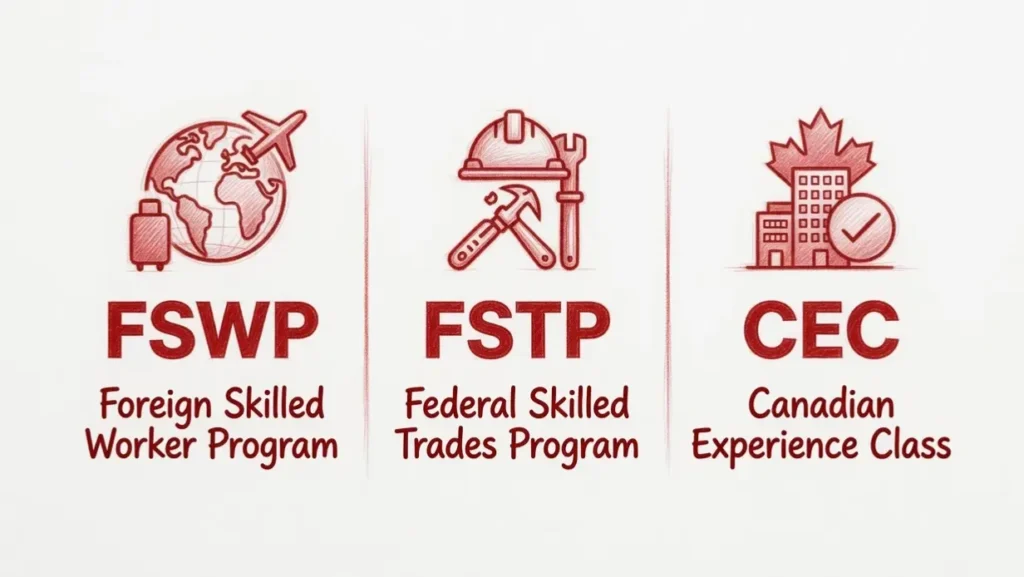
The difference between FSWP, CEC, and FSTP comes down to one question: where did you gain your skilled work experience? If your experience is from outside Canada, you enter under FSWP.
If you have at least one year of Canadian skilled work, you qualify for CEC which has been the most active Express Entry draw stream in 2026, with cutoffs ranging from 507 to 518.
If you are a tradesperson with a Canadian job offer or provincial certificate, FSTP is your pathway. Choosing the wrong program can cost you access to the most competitive draws running right now.
In 14 years of tracking Canadian immigration, I have seen candidates consistently make the same mistake: entering under FSWP when they already have Canadian work experience that qualifies them for CEC, the program with the most frequent draws in 2026.
The program comparisons below are verified against IRCC’s official program pages on canada.ca as of June 2026.
Where proposed changes under the Federal High-Skilled Class reform are discussed, they are clearly labelled as pending implementation.
FSWP vs CEC vs FSTP: Quick Comparison Table
| Criteria | FSWP | CEC | FSTP |
|---|---|---|---|
| Best for | Foreign-educated professionals | Workers already in Canada | Tradespeople |
| Work experience location | Foreign or Canadian | Canadian only | Foreign or Canadian |
| Minimum experience | 1 year continuous (last 10 yrs) | 1 year Canadian (last 3 yrs) | 2 years in trade (last 5 yrs) |
| Language minimum | CLB 7 all abilities | CLB 5–7 depending on NOC | CLB 4–5 (lower) |
| 67-point grid | Required | Not required | Not required |
| Education requirement | High school + ECA | None | None |
| Proof of funds | Required (unless job offer) | Not required | Required (unless job offer) |
| Job offer required | No (adds points) | No | Yes (or provincial certificate) |
| Draw frequency in 2026 | Rare — included in category draws | Very frequent | Rare — included in trades category |
| 2026 CRS range | Varies by category | 507–518 | 477 (trades category) |
The single most important column in this table is draw frequency. In 2026, IRCC has run CEC-specific draws almost exclusively for the federal stream. Candidates in FSWP without a qualifying category have been waiting significantly longer.
Federal Skilled Worker Program (FSWP) — For Candidates With Foreign Experience
FSWP is designed for skilled professionals whose primary work experience is outside Canada. It is the only Express Entry program that fully accepts foreign work experience for eligibility.
Engineers, IT professionals, healthcare workers, and business managers applying from abroad typically enter under FSWP.
The 67-Point Grid: FSWP’s Unique Pre-Screening Requirement
FSWP is the only program that requires candidates to pass a separate 67-point selection grid before entering the Express Entry pool.
This grid is different from the CRS score, it is a pass/fail eligibility filter.
| Factor | Maximum Points |
|---|---|
| Age | 12 |
| Education | 25 |
| Language proficiency | 28 |
| Work experience | 15 |
| Arranged employment (job offer) | 10 |
| Adaptability | 10 |
| Total | 100 |
You need at least 67 out of 100 to qualify. Most candidates with a Bachelor’s degree, CLB 7 language scores, and one year of work experience can reach 67.
But if you fall short, you cannot enter the pool under FSWP regardless of your CRS score.
Source: IRCC — Federal Skilled Worker Program requirements
FSWP in 2026: The Draw Reality
IRCC has not held a standalone FSWP general draw since transitioning to category-based selection as the primary draw mechanism.
FSWP candidates receive ITAs through category draws: healthcare, STEM, French-language, senior managers — or through general all-program draws, which have been rare in 2026.
If you are in the pool under FSWP without qualifying for a category, your wait time is significantly longer than a CEC candidate with a similar CRS score.
See all 2026 Express Entry draw results and which programs were selected
Canadian Experience Class (CEC) — For Candidates Already Working in Canada
CEC is the most strategically important program in 2026. It targets temporary foreign workers, post-graduation work permit holders, and international students who have transitioned to employment in Canada.
One year of skilled Canadian work experience is the core requirement and it is the single factor that separates CEC candidates from everyone else in the current draw environment.
CEC Eligibility Requirements
- At least one year of full-time skilled work experience in Canada within the last three years or equivalent part-time hours totalling 1,560 hours
- Work must be in a TEER 0, 1, 2, or 3 occupation under Canada’s NOC system
- Experience must have been gained while holding valid legal status in Canada, work permit, study permit with work authorization, or other authorized status
- CLB 7 or higher for TEER 0 and 1 occupations; CLB 5 or higher for TEER 2 and 3
Foreign work experience does not count toward CEC eligibility. Only Canadian-authorized employment qualifies.
Source: Canadian Experience Class requirements
Why CEC Is the Strongest Strategy in 2026
Three specific advantages make CEC the priority program this year:
No proof of funds required. CEC candidates are exempt from showing settlement funds because IRCC recognises their existing Canadian ties and employment. This removes a significant financial barrier.
Most active draw stream. CEC draws have run 12 times in 2026 as of May 28, with cutoffs between 507 and 518. No other federal stream has drawn this frequently.
Lower effective CRS threshold. Because CEC draws are program-specific, CEC candidates compete only against other CEC candidates — not the entire pool. This creates a more level playing field than a general all-program draw.
The May 27, 2026 CEC draw issued 3,000 ITAs at a cutoff of 518, the highest CEC cutoff of the year, driven by a 29-day pause that allowed the pool to grow.
Even at 518, candidates with one year of Canadian experience and CLB 9 language scores can realistically reach this range.
Calculate your CRS score and see if you are competitive for CEC draws
Federal Skilled Trades Program (FSTP): For Qualified Tradespeople
FSTP addresses Canada’s skilled trades shortage by targeting electricians, plumbers, welders, carpenters, heavy equipment operators, and other TEER 2 and 3 trade occupations. It does not require a university education, trade-specific skills and certifications are what matter.
FSTP Eligibility Requirements
- At least two years of full-time skilled trades work experience within the last five years in a qualifying NOC code
- Either a valid full-time job offer from a Canadian employer in the same trade, OR a Certificate of Qualification from a provincial or territorial regulatory body
- CLB 5 for speaking and listening; CLB 4 for reading and writing, the lowest language requirements of any Express Entry program
The job offer or provincial certificate requirement is the most significant difference between FSTP and the other two programs. Without one of these, you cannot enter the pool under FSTP.
FSTP in 2026 — Trade Occupations Category
IRCC held a Trade Occupations category draw in 2026 at CRS 477 — 30 to 40 points below the CEC cutoff. For tradespeople who qualify for the category, this is a meaningful advantage.
The trades category does not require an FSTP profile specifically — FSWP candidates with qualifying trade NOC codes are also eligible.
Which Program Should You Choose?
Use this decision framework based on your situation:
If you have Canadian work experience → CEC first, always.
Even one year of Canadian skilled work experience qualifies you for CEC. Enter the pool under CEC rather than FSWP. You get access to the most active draw stream, no proof of funds requirement, and you compete in a smaller candidate pool.
If all your experience is foreign → FSWP.
Check whether you pass the 67-point grid first. If you do, enter under FSWP and simultaneously pursue a qualifying category — French language, healthcare, STEM, or your specific occupation category. A provincial nomination is the fastest path to an ITA for most FSWP candidates without a category.
If you are a tradesperson → FSTP or trades category.
If you have a Canadian job offer or provincial certificate, enter under FSTP. If not, check whether your NOC code qualifies for the trades occupations category under FSWP or CEC.
If you qualify for multiple programs → CEC takes priority.
IRCC invites candidates under the most favourable program when multiple qualifications exist. If you qualify for both FSWP and CEC, your profile is treated as CEC-eligible for draw purposes.
Check your full eligibility requirements for each program
The Proposed Reform — What Happens to FSWP, CEC, and FSTP
IRCC has proposed retiring all three programs and replacing them with a single Federal High-Skilled Class. Public consultations ran through May 2026. No implementation date has been confirmed as of June 2026.
What Changes Under the New Class
The 67-point FSWP grid will be retired. A single streamlined eligibility requirement replaces it, one year of skilled work experience (Canadian or foreign, cumulative) and a language baseline of CLB 6. Foreign and Canadian experience are treated more equally under the new system.
What Stays the Same
The CRS scoring system remains. Category-based draws continue. The pool structure is unchanged. Candidates already in the pool under existing programs are not removed when the reform takes effect.
What This Means for You Now
If you are building your profile today, proceed under the current three-program system. The reform is not in effect and the timeline is uncertain. Focus on entering the correct program for maximum draw access right now rather than waiting for a system that has no confirmed launch date.
Source: Express Entry reform consultations 2026
Program-Specific CRS Points — How Each Program Affects Your Score
Your program choice affects your CRS score in specific ways beyond just eligibility.
Canadian work experience points (core factors):
- CEC candidates with 1 year Canadian experience: 40 points (single) or 35 points (with spouse)
- CEC candidates with 5+ years: 80 points (single) or 70 points (with spouse)
- FSWP candidates with foreign experience only: 0 Canadian experience points
Proof of funds exemption value:
Not a CRS point but a strategic advantage — CEC candidates do not need to hold and prove CAD $14,690 in liquid assets while waiting in the pool.
Skill transferability bonuses:
CEC candidates with foreign work experience also get skill transferability bonus points for the combination of Canadian + foreign experience — up to 25 additional points.
See the full CRS score breakdown with every factor explained
Frequently Asked Questions — FSWP vs CEC vs FSTP
Can I be eligible for more than one Express Entry program at the same time?
Yes. Many candidates qualify under both FSWP and CEC simultaneously. IRCC treats your profile as eligible for the most favourable program in draw selection. If CEC draws are running, CEC eligibility takes effective priority.
Which program is fastest in 2026?
CEC. It has produced the most draws and the most ITAs of any federal stream in 2026. For candidates already in Canada with one year of skilled work, CEC is the clear fastest path.
Does my Canadian student work experience count for CEC?
Yes, if the work was in a TEER 0, 1, 2, or 3 occupation and you held valid authorisation to work — such as a study permit with on-campus or off-campus work authorisation, or a co-op work permit. Hours must total at least 1,560 for full-time equivalent.
What happens to my FSWP profile if the reform passes?
IRCC has confirmed that existing profiles will not be invalidated by the reform. Current candidates remain in the pool under existing rules until the new Federal High-Skilled Class is implemented.
I have two years of foreign experience and six months of Canadian experience — which program?
You likely qualify under both FSWP (two years foreign) and partially under CEC (six months Canadian, not yet the one-year minimum).
Continue gaining Canadian experience until you reach one year, then you can enter as CEC-eligible. In the meantime, FSWP is your entry program.
Does FSTP have a separate draw from CEC and FSWP?
In 2026, IRCC has not held standalone FSTP draws. Tradespeople receive ITAs through the Trade Occupations category draws, which are open to all programs as long as your NOC code qualifies.
Is the 67-point FSWP grid calculated the same way as CRS?
No. They are completely separate calculations. The 67-point grid is a pass/fail eligibility filter for entering the pool under FSWP.
The CRS score (up to 1,200) is the ranking system used to select candidates in draws. You must pass the 67-point grid to enter then your CRS determines when you get selected.
What NOC codes qualify for FSTP?
FSTP qualifying trades fall primarily under TEER 2 and 3 in the NOC system, including major groups for industrial, electrical, construction, and maintenance trades, as well as chef occupations. Check the official IRCC FSTP page for the current complete list.
Find your NOC code and confirm your TEER level
About The Author