


Good news for Express Entry candidates: Immigration, Refugees and Citizenship Canada (IRCC) has significantly reduced processing delays, with the Express Entry backlog reaching a record low of just 10% as of March 31, 2026.
This marks the lowest level since IRCC began publishing detailed backlog statistics.
This improvement comes as a major relief for skilled immigrants waiting for permanent residence decisions.
Faster processing times mean shorter wait periods and greater certainty for applicants who have already received Invitations to Apply (ITAs).
Key Highlights from IRCC’s March 2026 Inventory Report
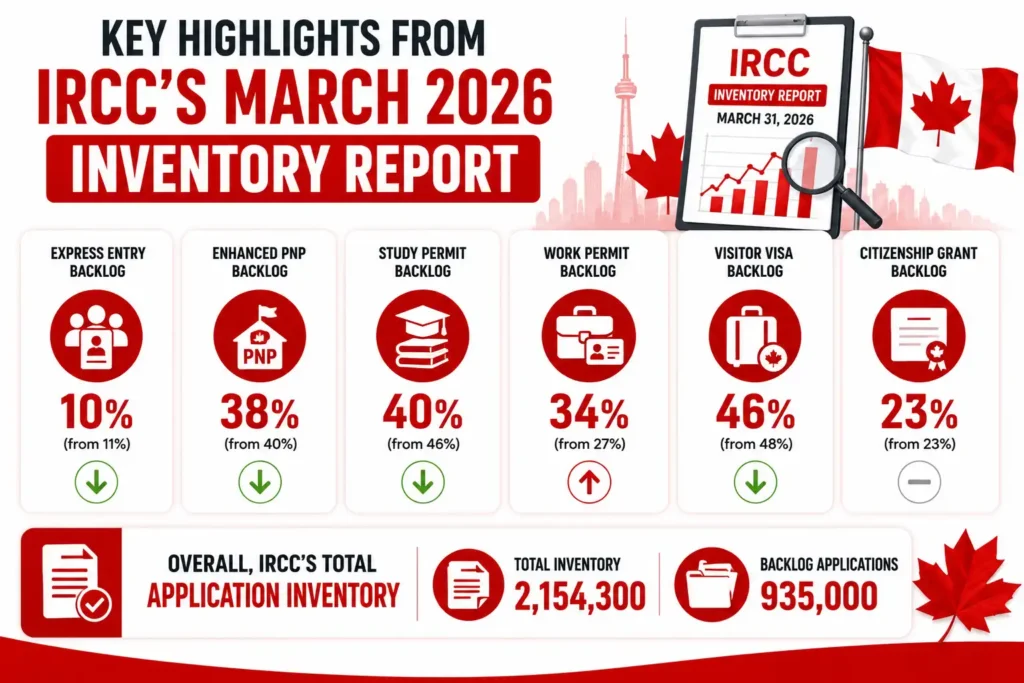
IRCC released its latest application inventory data on May 22, 2026, covering the period ending March 31, 2026. Here are the most important developments:
- Express Entry backlog: Dropped to 10% (from 11% in February 2026)
- Enhanced Provincial Nominee Program (PNP) backlog: Fell to 38% (from 40%)
- Study permit backlog: Improved to 40% (from 46%)
- Work permit backlog: Rose to 34% (from 27%)
- Visitor visa backlog: Slightly better at 46% (from 48%)
- Citizenship grant backlog: Steady at 23%
Overall, IRCC’s total application inventory stood at 2,154,300, with 935,000 applications classified as backlog.
Express Entry Backlog Trends (2025–2026)
The Express Entry category has shown consistent improvement over recent months. Here’s how the backlog percentage has evolved:
| Month | Express Entry Backlog % | Change from Previous Month |
|---|---|---|
| November 2025 | 32% | – |
| January 2026 | – | Significant drop |
| February 2026 | 11% | – |
| March 2026 | 10% | -1% |
This 10% backlog is well below IRCC’s own projection of 20% for March, indicating stronger-than-expected processing performance.
Permanent Residence Applications Overview
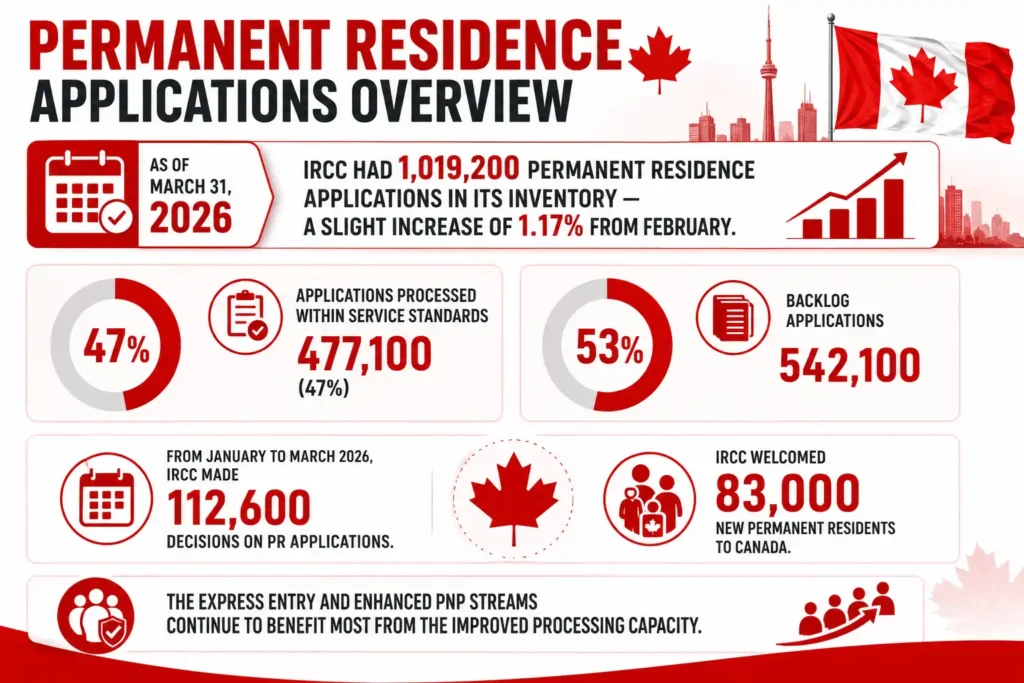
As of March 31, 2026, IRCC had 1,019,200 permanent residence applications in its inventory, a slight increase of 1.17% from February.
- Applications processed within service standards: 477,100 (47%)
- Backlog applications: 542,100
From January to March 2026, IRCC made 112,600 decisions on PR applications and welcomed 83,000 new permanent residents to Canada.
The Express Entry and enhanced PNP streams continue to benefit most from the improved processing capacity.
Temporary Residence Applications
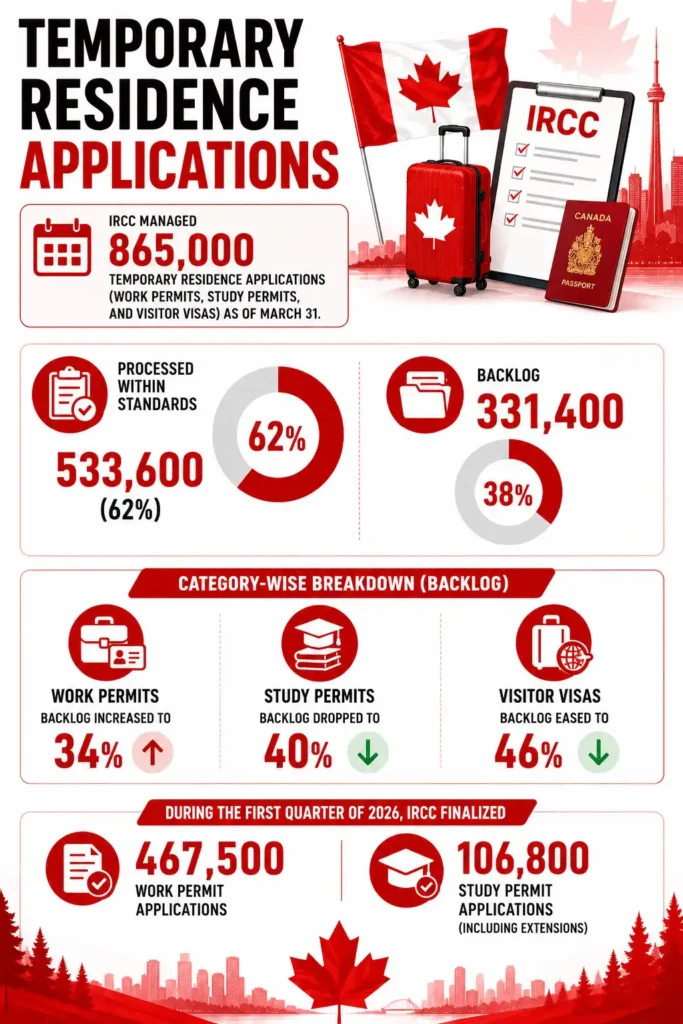
IRCC managed 865,000 temporary residence applications (work permits, study permits, and visitor visas) as of March 31.
- Processed within standards: 533,600 (62%)
- Backlog: 331,400
Category-wise breakdown:
- Work permits: Backlog increased to 34%
- Study permits: Backlog dropped to 40%
- Visitor visas: Backlog eased to 46%
During the first quarter of 2026, IRCC finalized 467,500 work permit applications and 106,800 study permit applications (including extensions).
Citizenship Applications
Citizenship processing remained stable:
- Total inventory: 270,100
- Backlog: 61,500 (23%)
IRCC welcomed 285,500 new citizens between April 2025 and March 2026.
What Does This Mean for Express Entry Candidates?
The record-low 10% backlog in Express Entry has several positive implications:
- Faster Final Decisions: Most applications are now being processed within or close to the six-month service standard.
- Reduced Uncertainty: Candidates with ITAs can expect quicker outcomes, helping with better financial and relocation planning.
- Improved Applicant Experience: Lower backlogs generally lead to fewer requests for additional documents and smoother overall processing.
- Continued Momentum: IRCC appears on track to meet its 2026 immigration targets more efficiently.
Comparison with Service Standards
IRCC aims to process 80% of applications within published service standards. Any file exceeding this timeframe counts toward the backlog.
- Express Entry service standard: Approximately 6 months
- Family sponsorship: 12 months
- Citizenship grants: Varies by type
The current data shows IRCC is performing better than its own targets in the Express Entry stream.
Tips for Candidates Currently in Process
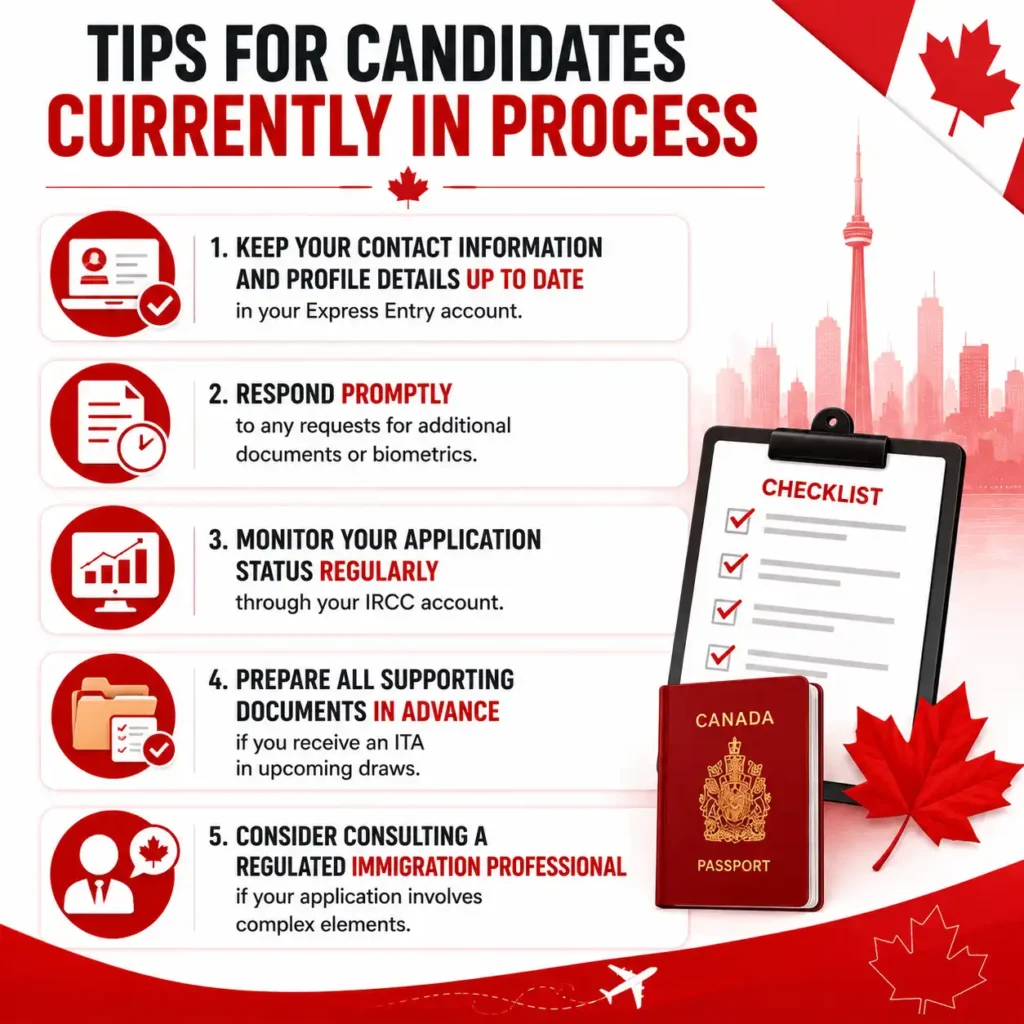
- Keep your contact information and profile details up to date in your Express Entry account.
- Respond promptly to any requests for additional documents or biometrics.
- Monitor your application status regularly through your IRCC account.
- Prepare all supporting documents in advance if you receive an ITA in upcoming draws.
- Consider consulting a regulated immigration professional if your application involves complex elements.
Check: Express Entry processing
What to Expect in Coming Months
With the Express Entry backlog at an all-time low and IRCC continuing to issue targeted draws (including PNP and category-based), processing times are expected to remain favorable through the rest of 2026.
However, work permit backlogs may need attention as they have shown some upward pressure.
This positive trend reflects IRCC’s efforts to streamline operations and reduce wait times, benefiting thousands of skilled immigrants hoping to build their future in Canada.
Frequently Asked Questions (FAQs)
How long does Express Entry processing take in 2026?
Most applications are now being processed within six months, with only 10% exceeding service standards.
Does a low backlog guarantee faster processing for my application?
It significantly improves the chances, but individual cases may still vary based on complexity, security checks, or missing documents.
Will the backlog continue to decrease?
IRCC has shown consistent progress in 2026. As long as application volumes remain manageable, the downward trend is likely to continue.
Should I apply now or wait for even better processing times?
If you meet eligibility criteria and have a strong profile, applying sooner is generally recommended to secure your place in the system.
Where can I check the latest IRCC backlog statistics?
The official data is published monthly on the Government of Canada website under application inventories.
About The Author