
By Elena Moreau, Immigration Policy Specialist · Updated June 8, 2026
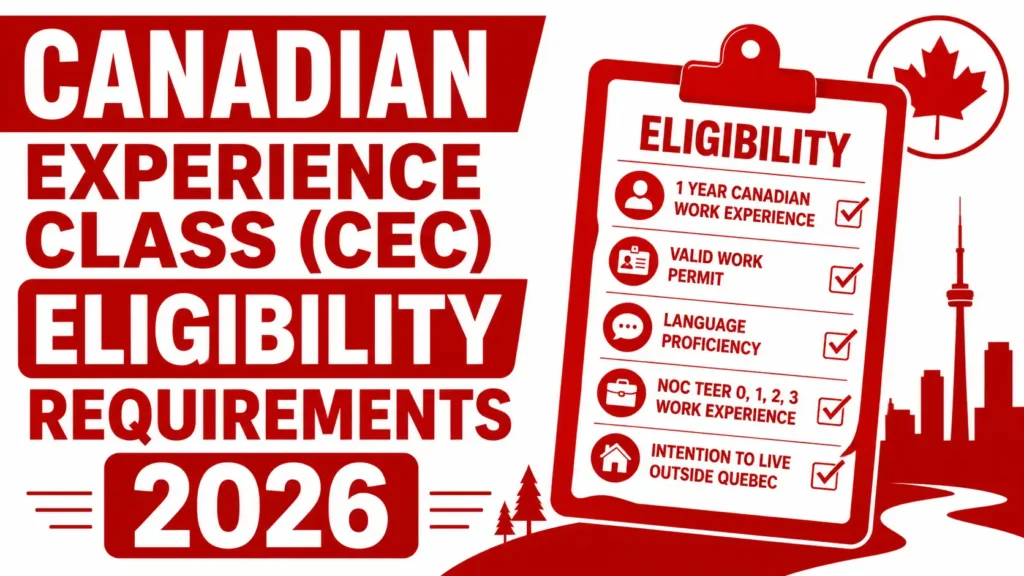
To qualify for the Canadian Experience Class in 2026, you need at least one year of full-time skilled work experience in Canada within the last three years, in a TEER 0, 1, 2, or 3 occupation, while holding valid legal status.
CEC has been the most active Express Entry draw stream in 2026, with 12 draws issued between January and May and CRS cutoffs ranging from 507 to 518.
If you meet CEC eligibility requirements, you are competing in the strongest draw position available in the current Express Entry pool.
Having reviewed Express Entry applications for over 14 years, CEC is consistently the program where I see candidates succeed fastest in 2026 — but also the one where the most preventable eligibility mistakes occur, particularly around work permit status and NOC code misidentification.
All CEC requirements below reflect IRCC’s official program criteria published on canada.ca as of June 2026. Any proposed changes under the Federal High-Skilled Class reform are labelled separately as pending implementation.
CEC Eligibility Requirements at a Glance
| Requirement | Minimum Standard |
|---|---|
| Work experience location | Inside Canada only |
| Minimum duration | 1 year full-time (1,560 hours) in last 3 years |
| NOC skill level | TEER 0, 1, 2, or 3 |
| Legal work status | Must have been authorised to work in Canada |
| Language (TEER 0 and 1) | CLB 7 in all four abilities |
| Language (TEER 2 and 3) | CLB 5 in all four abilities |
| Education | No minimum requirement |
| Proof of funds | Not required |
| Job offer | Not required |
| 67-point grid | Not required |
Source: IRCC — Canadian Experience Class requirements
CEC vs FSW: Which Draw Is Easier to Get ITA in 2026?
Requirement 1 — One Year of Skilled Canadian Work Experience
The foundation of CEC eligibility is one year of skilled work experience gained inside Canada.
This means 1,560 hours of work at a minimum of 30 hours per week, in a TEER 0, 1, 2, or 3 occupation, within the three years immediately before you apply.
Full-Time vs Part-Time
Full-time is defined as at least 30 hours per week. If you worked part-time, your hours can still count but must total 1,560 hours across all part-time positions combined.
You can combine hours from multiple part-time jobs in the same or different qualifying NOC codes, as long as each job individually meets the skilled occupation requirement.
One common scenario: an international graduate working 20 hours per week during their final semester and 40 hours after graduation. The 20-hour period counts toward the total as long as the work was authorised and in a qualifying NOC.
Continuous vs Non-Continuous Experience
Your one year of experience does not need to be continuous. Gaps between jobs are acceptable.
What matters is that the total hours within the three-year window reach 1,560 and each period of employment was legally authorised.
The Three-Year Window
All qualifying experience must fall within three years of the date you submit your Express Entry profile.
Experience older than three years does not count toward CEC eligibility, even if it was gained in Canada. This is why timing your profile submission correctly matters.
Source: IRCC — Canadian Experience Class work experience
Check if your occupation qualifies using the NOC code list
Requirement 2 — NOC TEER 0, 1, 2, or 3 Occupation
Your work experience must be in an occupation classified under TEER 0, 1, 2, or 3 in Canada’s National Occupational Classification system. TEER 4 and 5 occupations do not qualify for CEC.
What Each TEER Level Covers
| TEER Level | Typical Occupations |
|---|---|
| TEER 0 | Senior managers, legislators, senior officials |
| TEER 1 | Professional occupations requiring university degree (engineers, accountants, nurses) |
| TEER 2 | Technical occupations requiring college diploma or apprenticeship (technologists, supervisors) |
| TEER 3 | Occupations requiring secondary school and job-specific training (equipment operators, retail supervisors) |
| TEER 4 | Does NOT qualify (general labourers, service workers without supervision) |
| TEER 5 | Does NOT qualify (elemental labour, simple manual tasks) |
How to Confirm Your NOC Code
Your NOC code must match your actual primary job duties, not just your job title. IRCC reviews the duties listed in your reference letters against the NOC description. A mismatch is one of the most common reasons for CEC application refusal.
To confirm your NOC code, read the lead statement and main duties section of each NOC in the official IRCC database. If your daily tasks match at least 60 to 70 percent of the listed duties, that NOC is likely correct.
Full NOC code guide with TEER levels and how to identify your code
Source: IRCC — National Occupational Classification
Requirement 3 — Valid Legal Status While Working in Canada
Every hour of Canadian work experience you claim must have been worked while you held valid authorisation to work in Canada. IRCC verifies this against your immigration history.
Work Permits That Count
Open work permits count fully. These include the Post-Graduation Work Permit (PGWP), Spousal Open Work Permit, Bridging Open Work Permit (BOWP), and International Mobility Program permits.
Employer-specific work permits also count, as long as you were working for the employer listed on the permit and in the occupation specified.
Study Permit Work Authorisation
International students working during their studies can count those hours toward CEC if the work was in a qualifying NOC and was within their authorised work limits.
Students on a valid study permit are authorised to work up to 24 hours per week during academic sessions and full-time during scheduled breaks.
What Does Not Count
Unauthorised work, work performed after a permit expired, work done while on visitor status, and volunteer work do not count toward CEC eligibility.
If any portion of your claimed experience was performed without valid authorisation, it must be excluded entirely from your application.
Source: IRCC — Authorised work in Canada
Requirement 4 — Language Test Results
Language results are required for all CEC applicants. The minimum CLB level depends on your NOC TEER category.
| NOC TEER Level | Minimum CLB | IELTS Equivalent |
|---|---|---|
| TEER 0 and 1 | CLB 7 | 6.0 per band |
| TEER 2 and 3 | CLB 5 | 5.0 per band |
Which Tests Are Accepted
For English: IELTS General Training or CELPIP General. For French: TEF Canada or TCF Canada. Academic versions of IELTS are not accepted for Express Entry.
Language Test Validity
Results must have been issued within two years of submitting your Express Entry profile. An expired test reduces your CRS score automatically. If your test expires while your profile is in the pool, IRCC recalculates your score downward without notification.
Why CLB 7 Is Just the Minimum
CLB 7 gets you into the pool but is not competitive for CEC draws in 2026. With CEC cutoffs at 507 to 518, candidates need strong CRS scores.
Moving from CLB 7 to CLB 9 across all four abilities adds 52 CRS points for a single applicant. That difference alone can determine whether you receive an ITA this year or wait significantly longer.
How to score CLB 9 in IELTS — the 8777 formula explained
Source: IRCC — Language testing for Express Entry
CEC Advantages Over FSWP and FSTP
CEC has three structural advantages that make it the strongest Express Entry program in 2026.
No Proof of Funds Required
CEC candidates are completely exempt from the settlement funds requirement. FSWP and FSTP candidates without a valid job offer must demonstrate CAD $14,690 for a single applicant in liquid, unencumbered funds.
For candidates already paying rent, living expenses, and tuition in Canada, not having to hold and prove $14,690 in accessible savings is a meaningful practical advantage.
No 67-Point Grid
FSWP requires candidates to pass a separate 67-point selection grid as a pre-screening step before entering the pool. CEC has no such requirement.
If you meet the three core CEC requirements — one year Canadian experience, qualifying NOC, valid legal status, and language results — you enter the pool directly.
Most Active Draw Stream in 2026
CEC draws have run 12 times between January 5 and May 28, 2026. French-language draws have run 6 times. General all-program draws have been rare. For a candidate with CEC eligibility and a competitive CRS score, the draw opportunity is significantly higher than for FSWP candidates waiting for a general draw.
Track every 2026 CEC draw result with CRS cutoffs and ITAs issued
How CEC Experience Boosts Your CRS Score
Meeting CEC eligibility does not just open the program — it directly adds CRS points in two ways.
Canadian Work Experience Points
| Canadian Work Experience | CRS Points (Single) | CRS Points (With Spouse) |
|---|---|---|
| 1 year | 40 | 35 |
| 2 years | 53 | 46 |
| 3 years | 64 | 56 |
| 4 years | 72 | 63 |
| 5 or more years | 80 | 70 |
Skill Transferability Bonus Points
CEC candidates who also have foreign work experience get additional skill transferability points for the combination of Canadian and foreign experience:
- Canadian experience + 1 to 2 years foreign experience: 13 bonus points
- Canadian experience + 3 or more years foreign experience: 25 bonus points
These transferability points stack on top of your core Canadian experience points. A candidate with 2 years of Canadian experience and 3 years of foreign experience earns 53 core points plus 25 transferability points from that combination alone.
Calculate your total CRS score including CEC and transferability points
Common CEC Eligibility Mistakes That Cause Refusals
These are the most frequent errors that cause CEC applications to be refused or profiles to be ineligible.
Wrong NOC code. Claiming a TEER 1 NOC for a role whose duties are actually TEER 3 is misrepresentation. IRCC reviews your reference letters against the NOC description. The match must be accurate.
Counting unauthorised work. Hours worked after a permit expired, during a period of implied status when work was not authorised, or in a different occupation than permitted cannot be counted.
Reference letter does not meet IRCC standards. Reference letters must be on company letterhead, signed by a supervisor or HR representative, and include your job title, NOC code, salary, hours per week, start and end dates, and a description of your main duties. A generic employment verification letter is not sufficient.
Experience outside the three-year window. Canadian work experience earned more than three years before your profile submission date does not count toward CEC eligibility, even if it was in a qualifying NOC.
Mixing authorised and unauthorised hours. If you worked 800 authorised hours and 200 unauthorised hours, only the 800 authorised hours count. You must reach 1,560 authorised hours to qualify.
CEC and the Proposed Express Entry Reform
IRCC has proposed replacing CEC, FSWP, and FSTP with a single Federal High-Skilled Class. Under the proposed reform, the distinction between Canadian and foreign work experience becomes less rigid. One year of cumulative skilled experience — from inside or outside Canada — would satisfy the baseline requirement.
This change would give FSWP candidates access to the same draw pool that CEC candidates currently dominate. For existing CEC candidates in the pool, this means more competition when the reform takes effect.
No implementation date has been confirmed as of June 2026. Current CEC rules remain in effect for all draws until IRCC officially announces otherwise.
Full guide to the Express Entry reform and what it means for your application
Source: IRCC — Express Entry reform consultations
Frequently Asked Questions — CEC Eligibility 2026
Can I use Canadian work experience from a co-op program toward CEC?
Yes, if the co-op work was in a TEER 0, 1, 2, or 3 occupation and you held valid work authorisation through your study permit. Co-op hours count the same as regular employment hours.
Does self-employment in Canada count for CEC?
Generally no. IRCC does not typically count self-employment toward CEC work experience because it cannot be verified through a standard reference letter process. Incorporated businesses with arm’s length employment arrangements may qualify in specific circumstances. Consult an RCIC if your situation involves self-employment.
Can I qualify for CEC while still on a work permit?
Yes. You do not need to complete your work experience before submitting your profile. As long as you will have accumulated 1,560 hours of qualifying experience by the time you receive an ITA and submit your PR application, you can create your profile while your experience is still in progress.
What if my NOC code changed between jobs?
Each job is assessed individually. If your first job was TEER 2 and your second job is TEER 1, both periods count separately as long as each individually meets the definition of skilled work. You do not need to have worked in the same NOC throughout.
Does part-time work during a full-time study permit count?
Yes. Students authorised to work on a study permit can work up to 24 hours per week during academic sessions. Those hours in a qualifying NOC count toward the 1,560-hour CEC requirement.
Is there a minimum salary requirement for CEC?
No. IRCC does not set a minimum salary for CEC eligibility. However, your salary must be consistent with the prevailing wage for the occupation in the region where you worked, as this is one indicator that the job was genuine skilled employment.
How does IRCC verify my Canadian work experience?
IRCC reviews your reference letters, pay stubs, T4 slips, and employment records. Your claimed experience must be consistent across all documents. IRCC may also contact your employer directly in some cases.
What CRS score do I need to get selected in a CEC draw?
In 2026, CEC draw cutoffs have ranged from 507 to 518. Your score depends on your age, language results, education, and additional factors. Use our CRS calculator to see your current score against these cutoffs.
About The Author