
By Elena Moreau, Immigration Policy Specialist · Published June 2026
In 2026, CEC draws are significantly easier to get an ITA from than FSW draws. Not because the CRS cutoff is lower, but because CEC draws actually happen.
IRCC has held 12 Canadian Experience Class draws between January and May 2026, while standalone Federal Skilled Worker draws have been virtually absent all year.
If you qualify for both programs, CEC gives you 12 chances at an ITA where FSW gives you close to zero. The real question is not which draw has a lower cutoff. It is which draw actually runs.
CEC vs FSW Draws in 2026: The Numbers That Matter
Before comparing CRS scores, compare opportunity. This is the data most Express Entry candidates never look at before choosing their program.
| Metric | CEC Draws | FSW General Draws |
|---|---|---|
| Draws held Jan to May 2026 | 12 | 0 standalone |
| Total ITAs issued | 35,000 plus | 0 from standalone draws |
| CRS cutoff range | 507 to 518 | No standalone data |
| Average gap between draws | 10 to 15 days | No pattern in 2026 |
| Candidates competing | CEC eligible only | Entire pool |
The conclusion is straightforward. CEC eligible candidates in 2026 have had 12 draw opportunities. FSW candidates without a qualifying occupation category have had none from dedicated federal draws.
Tracking every Express Entry draw since 2015, the shift toward CEC priority in 2026 is sharper than anything seen in previous years. IRCC is not just slightly favouring in-Canada applicants. It has restructured the entire draw schedule around them.
Source: IRCC Express Entry rounds of invitations 2026
See every 2026 draw result with full CRS data and draw type
Why IRCC Runs CEC Draws So Much More Often Than FSW
This is not random scheduling. The dominance of CEC draws in 2026 reflects deliberate immigration policy that has been building since 2023 and reached full effect this year.
IRCC’s 2026 immigration levels plan explicitly targets temporary residents already living and working in Canada for permanent residence.
Post-graduation work permit holders, open work permit holders, and employer-specific permit holders are the primary group.
The Canadian Experience Class is the federal mechanism for selecting these candidates. Every CEC specific draw is a direct implementation of that policy priority.
Federal Skilled Worker candidates apply from outside Canada. They fall outside the in-Canada priority group that is shaping the 2026 draw schedule.
The second factor is category-based selection. Since IRCC introduced occupation-targeted draws in 2023, general all-program rounds that historically served FSW candidates have become rare events.
IRCC now directs ITA volumes toward specific occupation groups through categories like French language proficiency, healthcare occupations, trade occupations, and senior managers.
FSW candidates only receive ITAs when they qualify for one of these active categories.
Source: IRCC category-based selection for Express Entry 2026
Why CEC Cutoffs Are Higher But CEC Is Still Easier
CEC draw cutoffs in 2026 have ranged from 507 to 518. That sounds high. But the key context is that CEC eligible candidates compete only against other CEC candidates, not the full Express Entry pool.
A smaller competing pool means each candidate has a proportionally better shot at the ITAs being issued.
FSW candidates in a general draw compete against every profile in the pool regardless of program. When general draws have run historically, the cutoff reflects the entire pool distribution, which tends to be lower in raw number but far more competitive in practice because the pool is much larger.
Three CRS factors explain why CEC candidates consistently score higher despite both groups having similar education and foreign work experience.
First, Canadian work experience adds 40 to 80 CRS points directly to the core human capital section. One year of Canadian skilled work is worth 40 points.
Five or more years is worth 80 points. FSW candidates with only foreign experience receive zero points in this category.
Second, the skill transferability bonus rewards candidates who combine Canadian work experience with foreign work experience, up to 25 additional points. Many CEC candidates who worked abroad before coming to Canada qualify for this combination bonus.
Third, Canadian education adds 15 to 30 points in the additional factors section. Many CEC candidates came through the international student pathway and completed a Canadian degree or diploma before starting work.
These three factors together can add 70 to 135 CRS points to a CEC candidate profile compared to an otherwise identical FSW candidate with only foreign experience and education.
Calculate your exact CRS score under CEC and FSWP scenarios
The One Situation Where FSW Has a Clear Advantage
Despite the CEC dominance in 2026, there is a specific profile where an FSW candidate has a more direct path to an ITA than a CEC candidate without French. It is worth understanding clearly.
French language draws ran at CRS scores between 393 and 419 in 2026. Any candidate in the pool qualifies for French language draws regardless of which program they are under, as long as they demonstrate CLB 7 or higher across all four French abilities through TEF Canada or TCF Canada.
An FSW candidate with French at CLB 7 has access to draws running at 393. A CEC candidate without any French proficiency must wait for CEC draws at 507 to 518.
The gap between those two cutoffs is more than 100 points. One language test in French can open a faster route to permanent residence than years of waiting in a CEC eligible pool.
This advantage applies equally to CEC candidates who speak French, but it is particularly significant for FSW candidates who otherwise have no active federal draw stream in 2026.
If you are building your Express Entry strategy as an FSW candidate right now, French language testing is the single most impactful action you can take this year.
How the French language category draw works and who qualifies
Choosing Between CEC and FSW: A Practical Decision Guide
Choose CEC if you have at least one year of full-time skilled Canadian work experience within the last three years in a TEER 0, 1, 2, or 3 occupation, and that work was done while holding valid legal status in Canada.
CEC gives you access to the most active draw stream of 2026 and exempts you from the proof of funds requirement of CAD 14,690 for a single applicant.
Choose FSW if all or most of your skilled work experience is outside Canada and you have not yet accumulated one year of Canadian work experience.
Enter under FSW, identify which active category matches your occupation or language profile, and pursue that category while building toward CEC eligibility if you are or will be working in Canada.
If you qualify for both programs simultaneously, IRCC treats your profile as CEC eligible for draw selection purposes. You do not choose between them at the draw stage. The system considers you for the most favourable draw type automatically.
Source: IRCC Express Entry eligibility by program
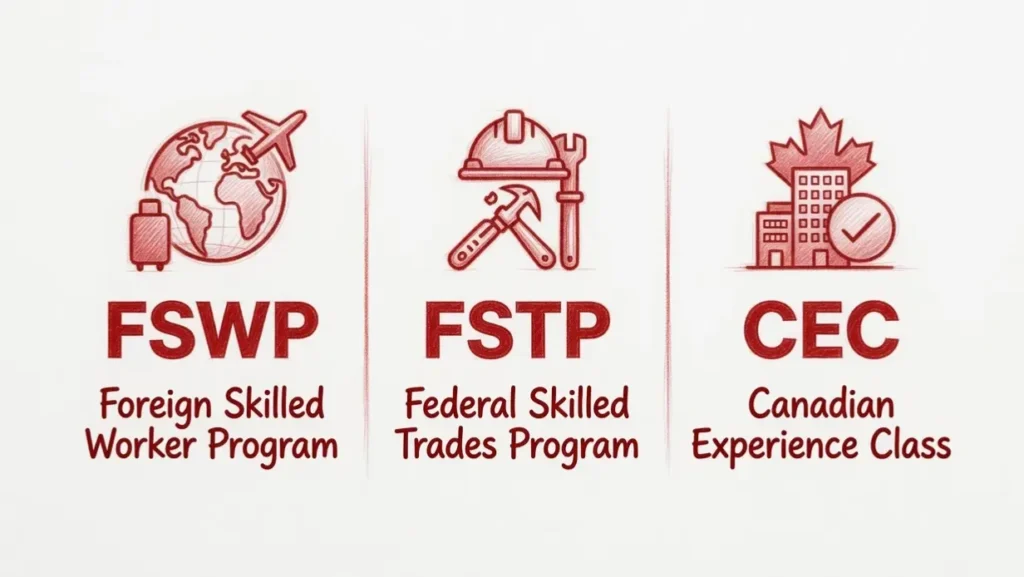
Full breakdown of FSWP, CEC, and FSTP requirements side by side
What the May 2026 CEC Pause Reveals About Draw Strategy
The 29-day gap between CEC draws in April and May 2026 is the most instructive data point of the year for understanding how CEC draws actually work.
Many candidates assumed a long pause would result in a lower cutoff when IRCC resumed draws. The opposite happened. The May 27 CEC draw came back at 518, the highest CEC cutoff of 2026.
The reason is straightforward. When IRCC pauses CEC draws, high-scoring candidates continue accumulating in the CEC eligible pool.
When the draw resumes, the backlog of top-scoring profiles is larger than usual, and IRCC works through the highest scores first. Candidates sitting at 500 who expected the pause to create a drop were disappointed.
This same dynamic applies to FSW general draws. If IRCC were to run a general draw after an extended pause, the cutoff would reflect all the high-scoring profiles across every program that had been waiting. A pause does not create opportunity. It creates competition.
The practical lesson for both CEC and FSW candidates is the same. Submit your profile as early as possible, keep your language results valid, and update your profile immediately when any factor improves. Waiting for a draw pause to create a lower cutoff is not a strategy.
Will FSW Draws Return Before the End of 2026?
This is the question every FSW candidate outside Canada is asking. Based on current IRCC signals the honest answer is: not as standalone general draws, and possibly not before the program itself is retired.
IRCC’s proposed reform replaces FSWP, CEC, and FSTP with a single Federal High-Skilled Class. Public consultations ended in May 2026 and implementation is expected in late 2026 or 2027.
If the reform launches before a general FSW draw runs, standalone FSW draws may never return under the current program structure.
FSW candidates in 2026 have two realistic paths that do not depend on a general draw returning. The first is qualifying for an active category draw.
French language proficiency, healthcare occupations, trade occupations, senior manager NOC codes, and several other categories run draws open to all programs.
The second is a provincial nomination, which adds 600 CRS points and makes selection in the next PNP draw nearly certain regardless of which federal program you are under.
Source: IRCC Express Entry reform 2026
Frequently Asked Questions
Is the CRS cutoff lower in CEC draws or FSW draws?
In 2026, CEC draws have run between 507 and 518. There have been no standalone FSW general draws to compare directly. Category draws open to FSW candidates have run at 393 for French language, 467 for healthcare, and 477 for trades occupations. The comparison depends entirely on which category an FSW candidate qualifies for.
Can an FSW candidate receive an ITA in a CEC draw?
No. CEC specific draws issue ITAs only to CEC eligible candidates. FSW candidates who are not CEC eligible are excluded from those rounds.
If I qualify for both CEC and FSW, which program does IRCC use?
IRCC considers you for the most favourable draw type automatically. If a CEC draw is running and you meet CEC eligibility, you are included in that draw without needing to declare a preference.
How many CEC draws have run in 2026?
As of May 28, 2026, IRCC has held 12 CEC specific draws. Total ITAs issued in these rounds exceed 35,000.
What CRS score do I need for a CEC draw right now?
The most recent CEC draw on May 27, 2026 had a cutoff of 518. The 2026 range has been 507 to 518. Candidates in the 505 to 520 range are competitive for current CEC draws. The cutoff will vary with the next draw depending on pool size and ITA volume.
What is the realistic option for FSW candidates with no qualifying category?
Pursue French language testing if any French proficiency exists. Research provincial nominee programs that match your occupation. Continue accumulating Canadian work experience if you are in Canada. Waiting for a general draw is not a reliable strategy in the current draw environment.
Is it worth retaking IELTS to reach a higher CEC cutoff?
Yes if you are within 30 points of the current cutoff. Moving from CLB 8 to CLB 9 across all four skills adds 28 CRS points. For a CEC candidate at 490 this single improvement brings the score into the current competitive range for CEC draws.
See how much each factor adds to your CRS score
About The Author