
By Elena Moreau, Immigration Policy Specialist · Updated June 8, 2026
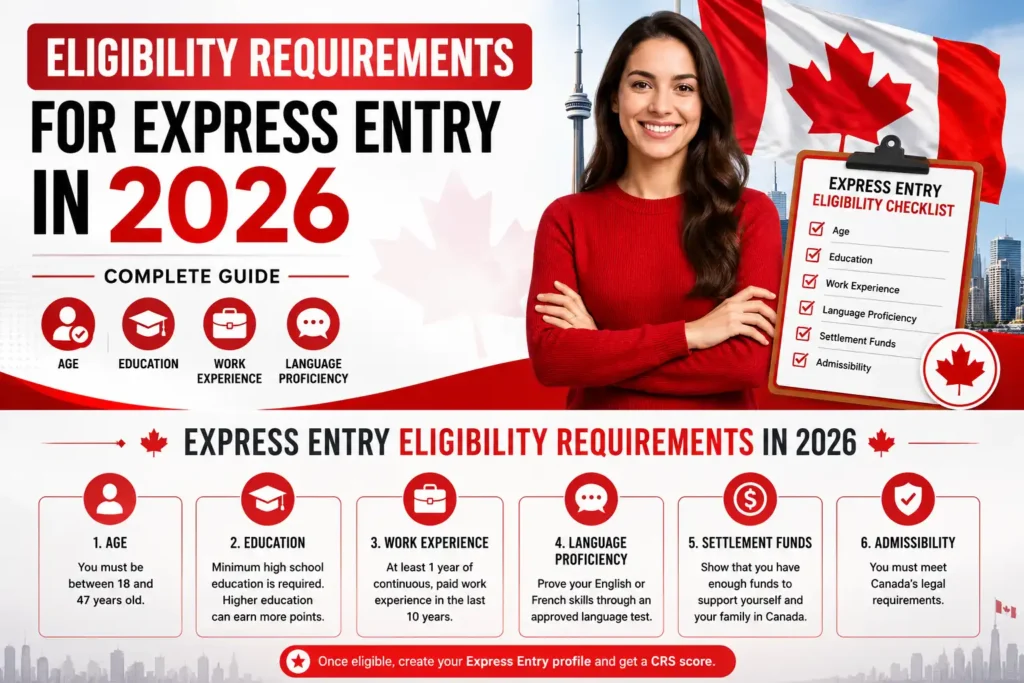
To qualify for Canada Express Entry in 2026, you need at least one year of skilled work experience in a TEER 0, 1, 2, or 3 occupation, a valid language test showing CLB 7 or higher, and an Educational Credential Assessment if your degree is from outside Canada.
Meeting these Express Entry eligibility requirements gets you into the pool but your CRS score determines when you get selected. In 2026, CEC draw cutoffs have ranged from 507 to 518, while French-language draws have gone as low as 393.
After reviewing hundreds of Express Entry profiles over 14 years, the most common eligibility mistake I see is candidates entering the pool under the wrong program, qualifying for CEC but filing under FSWP, which costs them access to the most active draw stream of 2026.
The eligibility rules below reflect IRCC’s current published criteria as of June 2026, verified against canada.ca and confirmed through IRCC’s official Express Entry program guides. Where proposed changes are discussed, they are clearly labelled as pending implementation.
Core Eligibility Requirements — The Minimum to Enter the Express Entry Pool
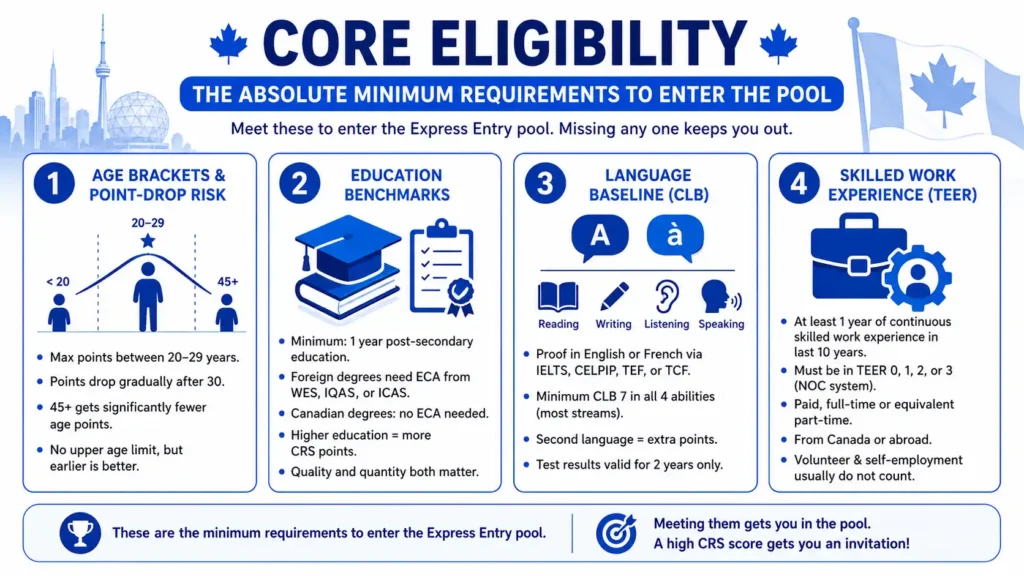
Every candidate must meet these four baseline requirements before creating an Express Entry profile. Failing any single one keeps you out of the pool entirely.
1. Skilled Work Experience
You need at least one year of full-time skilled work experience or an equivalent in part-time hours (1,560 hours total) within the last 10 years. Your occupation must fall under TEER 0, 1, 2, or 3 in Canada’s National Occupational Classification (NOC) system. TEER 4 and 5 jobs do not qualify.
Work experience must be paid. Volunteer work, unpaid internships, and self-employment generally do not count unless you can document it as structured business ownership with verifiable income. Experience can be from inside or outside Canada depending on which program you enter under.
Find your NOC code and TEER level — complete list and guide
Source: IRCC — Work experience requirements for Express Entry
2. Language Test Results
You must provide valid language test results from an approved test taken within the last two years. For English: IELTS General Training or CELPIP General. For French: TEF Canada or TCF Canada.
The minimum CLB level to enter the pool is CLB 7 for most programs but CLB 7 gives you the bare minimum CRS language points. In practice, candidates competing in CEC draws in 2026 need CLB 9 (IELTS 7.0 in each band) to be competitive.
The difference between CLB 7 and CLB 9 across all four skills is 52 CRS points which is the difference between waiting years and receiving an ITA this year.
| CLB Level | IELTS Equivalent | Points Per Skill (Single Applicant) |
|---|---|---|
| CLB 10+ | 8.0+ | 32 |
| CLB 9 | 7.0–7.5 | 29 |
| CLB 8 | 6.5 | 22 |
| CLB 7 | 6.0 | 16 |
| CLB 6 | 5.5 | 8 |
| Below CLB 6 | Below 5.5 | 0–6 |
Source: IRCC — Language testing for Express Entry
How to score CLB 9 in IELTS — the complete 8777 strategy
3. Educational Credential Assessment (ECA)
If your highest level of education was completed outside Canada, you must have an ECA from an IRCC-approved organisation. WES (World Education Services) is the most widely used. Others include IQAS, ICAS, and MCAS.
The ECA confirms that your foreign degree is equivalent to a Canadian credential and determines how many education CRS points you receive.
Without a valid ECA, IRCC will not give you full education points regardless of your actual qualification. A PhD from a foreign university without an ECA gives you zero education points in the CRS.
Canadian degrees and diplomas do not require an ECA.
Source: IRCC — Educational Credential Assessment for Express Entry
4. Proof of Settlement Funds
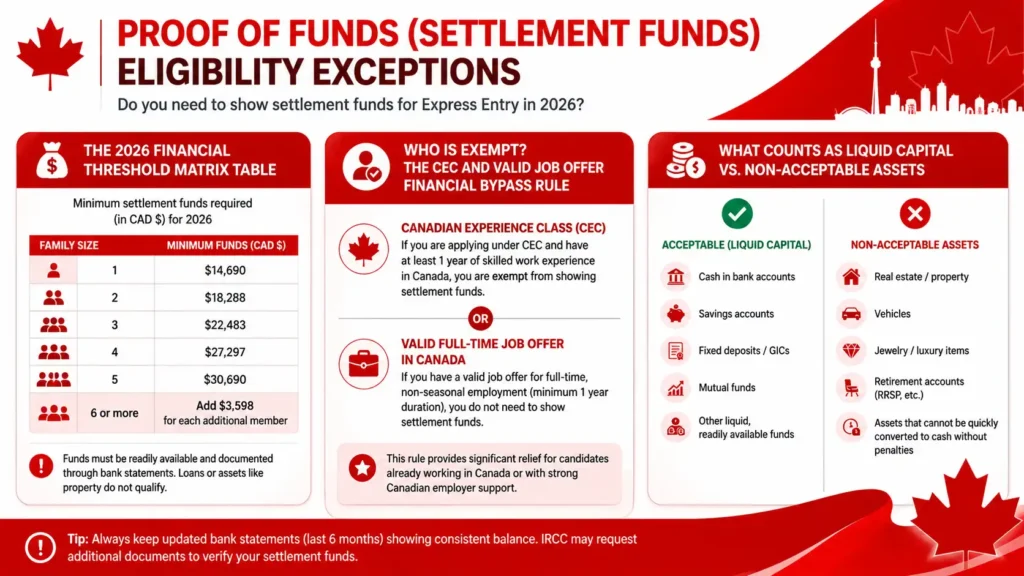
Most candidates must show they have enough money to support themselves and their family after arriving in Canada. Funds must be unencumbered, meaning they are not loans and are not collateral for any debt.
2026 Proof of Funds Requirements (updated annually by IRCC):
Updated July 29, 2025
| Number of family members | Funds you need (in Canadian dollars) |
|---|---|
| 1 | $15,263 |
| 2 | $19,001 |
| 3 | $23,360 |
| 4 | $28,362 |
| 5 | $32,168 |
| 6 | $36,280 |
| 7 | $40,392 |
| If more than 7 people, for each additional family member, add | $4,112 |
Source: IRCC
Who is exempt: Candidates applying under the Canadian Experience Class or those with a valid full-time job offer in Canada do not need to show proof of funds.
What counts as acceptable funds: Cash, bank deposits, fixed deposits, and liquid mutual funds. Vehicles, real estate, jewellery, and retirement accounts with early withdrawal penalties do not qualify.
Why IRCC rejects proof of funds — common mistakes and exact fixes
Stream-Specific Eligibility — FSWP, CEC, and FSTP
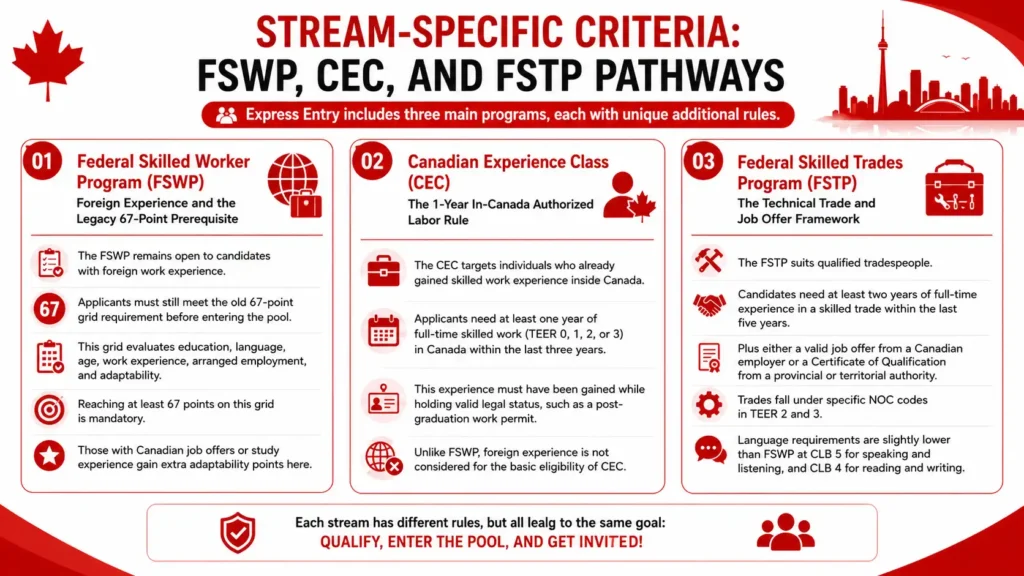
Beyond the baseline requirements, each Express Entry program has its own additional rules. Entering the wrong program can cost you access to draws you would have qualified for under the correct one.
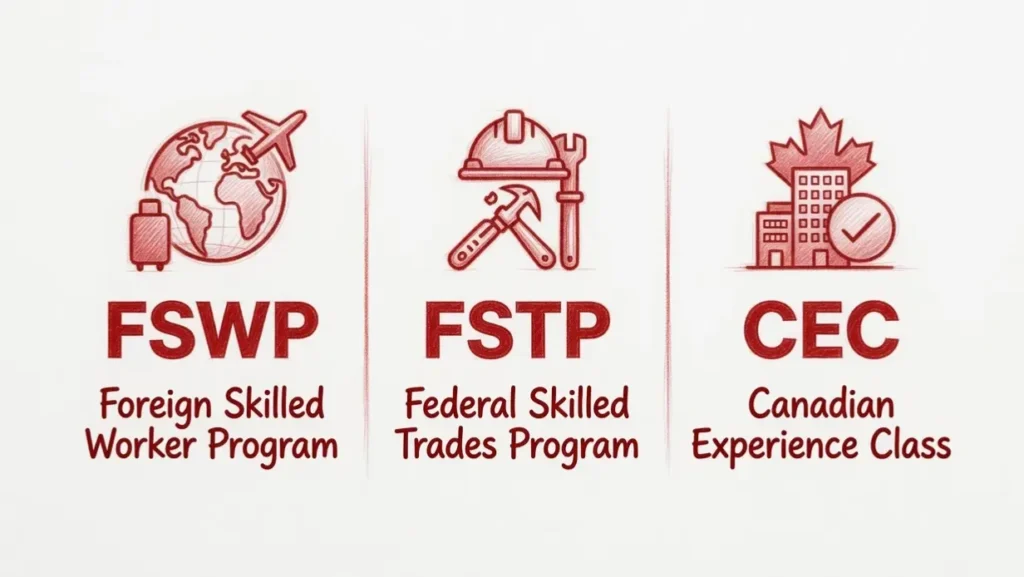
Federal Skilled Worker Program (FSWP) — For Candidates With Foreign Experience
FSWP is designed for candidates whose primary work experience is outside Canada. To qualify under FSWP you must:
- Have at least one year of continuous full-time foreign skilled work experience in the last 10 years in a TEER 0, 1, 2, or 3 occupation
- Score at least 67 points on the FSWP selection grid (covering education, language, age, experience, arranged employment, and adaptability)
- Meet CLB 7 or higher in all four language abilities
The 67-point FSWP grid is separate from the CRS score. You must pass it to enter the pool under FSWP — but passing it does not guarantee a competitive CRS score for current draws.
Source: IRCC — Federal Skilled Worker Program requirements
Canadian Experience Class (CEC) — For Candidates Already Working in Canada
CEC is for candidates who have gained skilled work experience inside Canada. In 2026 it has been the most active draw stream, with draws running every two to five weeks. To qualify:
- At least one year of full-time skilled work experience (TEER 0, 1, 2, or 3) in Canada within the last three years
- Experience must have been gained while holding valid legal status in Canada: work permit, study permit with work authorization, or other authorized status
- CLB 7 or higher for TEER 0 and 1 occupations; CLB 5 or higher for TEER 2 and 3
Foreign work experience does not count toward CEC eligibility — only Canadian experience qualifies.
Source: IRCC — Canadian Experience Class requirements
Federal Skilled Trades Program (FSTP) — For Qualified Tradespeople
FSTP targets qualified tradespeople with work experience in eligible skilled trade occupations. To qualify:
- At least two years of full-time skilled trades work experience in the last five years in a qualifying NOC code
- Either a valid job offer from a Canadian employer OR a Certificate of Qualification from a provincial or territorial body
- CLB 5 for speaking and listening; CLB 4 for reading and writing
Language requirements for FSTP are lower than FSWP and CEC, making it more accessible for tradespeople who may not have strong academic English or French.
Source: IRCC — Federal Skilled Trades Program requirements
Full comparison — FSWP vs CEC vs FSTP: which program fits your profile?
2026 Category-Based Selection — Additional Eligibility Criteria
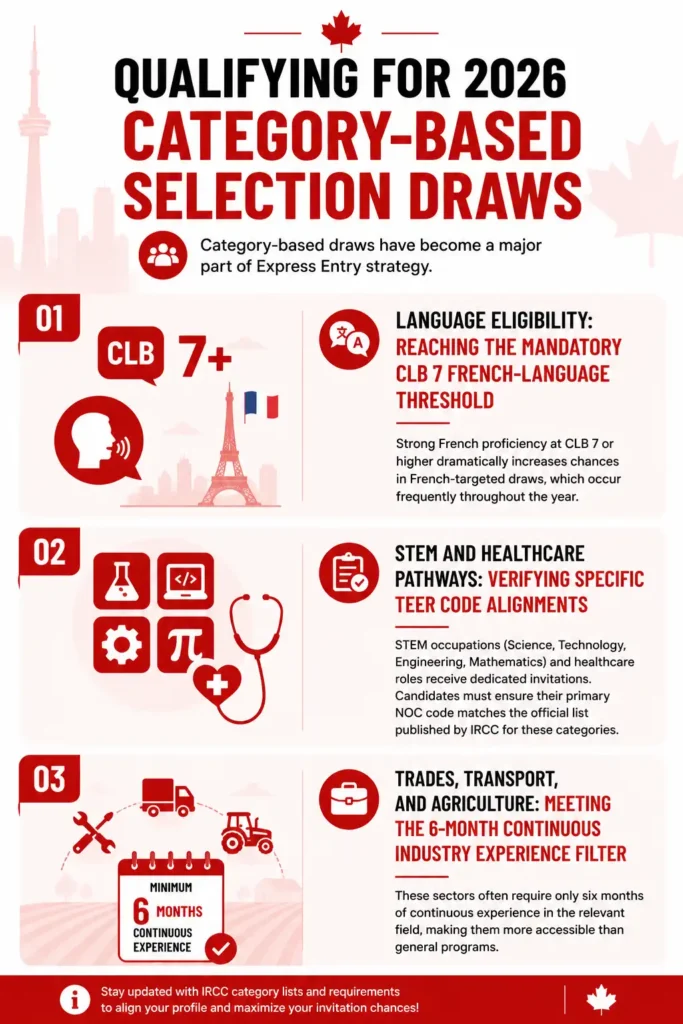
Category-based draws allow IRCC to invite candidates in specific occupations or language groups at CRS scores well below general draw cutoffs.
Qualifying for a category can be the difference between waiting two years and receiving an ITA this month.
French-Language Category
To qualify for French-language draws which ran at CRS scores as low as 393 in 2026, you must demonstrate CLB 7 or higher in all four French language abilities through TEF Canada or TCF Canada.
No specific work experience in a French-language occupation is required. You simply need the language score.
This is currently the fastest non-PNP path to an ITA for candidates with lower CRS scores.
Healthcare Occupations Category
Healthcare candidates must have at least 12 months of work experience within the last three years in a qualifying healthcare NOC code. The healthcare draw in 2026 ran at CRS 467, significantly below the CEC cutoff of 507–518.
Qualifying healthcare NOC codes include nurses (NOC 31301, 32101), physicians (NOC 31102), pharmacists (NOC 31120), and a range of allied health occupations.
Trades Occupations Category
Trades candidates need 12 months of experience in a qualifying trades NOC within the last three years. The 2026 trades draw ran at CRS 477.
STEM Occupations Category
STEM is a listed 2026 category but has held no draws for over 25 months as of June 2026. Do not rely on a STEM category draw — pursue CEC eligibility or a provincial nomination instead.
Source: IRCC — Category-based selection for Express Entry 2026
New Express Entry categories 2026 — full list and who qualifies
Admissibility Requirements: Health, Character, and Legal Background
Meeting the eligibility requirements above gets you into the pool. But IRCC also evaluates admissibility when you submit your PR application after receiving an ITA. Two issues can make an otherwise eligible candidate inadmissible.
Medical Inadmissibility
All candidates and accompanying family members must complete a medical examination with an IRCC-approved panel physician.
Certain health conditions may result in inadmissibility if they are likely to place excessive demand on Canadian health or social services. The excessive demand threshold in 2026 is approximately CAD $133,476 over five years.
Criminal Inadmissibility
You must provide police clearance certificates from every country where you have lived for six months or more since turning 18.
A criminal record does not automatically make you inadmissible, the outcome depends on the nature and severity of the offence and whether it has a Canadian equivalent.
Source: IRCC — Inadmissibility to Canada
Common Eligibility Mistakes That Get Profiles Rejected
These are the most frequent errors that cause candidates to either fail to enter the pool or receive lower CRS scores than they deserve.
Entering under FSWP when CEC applies. Candidates with Canadian work experience who enter under FSWP miss CEC draws entirely. Always check CEC eligibility first if you have any Canadian work experience.
Using an expired language test. Language results are only valid for two years. A test from June 2024 expires June 2026. If your results expire while in the pool, your CRS score drops automatically and without warning.
Submitting an ECA from a non-designated organisation. Only ECA reports from IRCC’s official list of designated organisations are accepted. A credential assessment from an unrecognised organisation gives you zero education points.
Claiming ineligible work experience. Volunteer work, unpaid internships, self-employment without proper documentation, and experience in TEER 4 or 5 occupations do not count.
IRCC verifies work experience through reference letters, if the letter does not include salary, exact dates, hours per week, and job duties, it may be rejected.
Misidentifying your NOC code. Your NOC code must match your primary duties, not just your job title. Using a TEER 1 NOC code for a role whose actual duties fall under TEER 3 is misrepresentation and can lead to application refusal.
Frequently Asked Questions — Express Entry Eligibility 2026
Can I enter the Express Entry pool without a job offer?
Yes. A job offer adds 50 to 200 CRS points but is not required for eligibility. The majority of candidates who received ITAs in 2026 did not have a job offer.
Does part-time work count toward the one-year experience requirement?
Yes, if the total hours equal at least 1,560 hours, the equivalent of one year of full-time work at 30 hours per week. Part-time hours from multiple jobs in the same NOC can be combined.
What is the minimum CRS score needed to get an ITA in 2026?
It depends on the draw type. The lowest 2026 cutoff was 391 in the Physicians draw. French-language draws have run 393 to 419. CEC draws have required 507 to 518. There is no single minimum, it changes with each draw.
Can I include my spouse in the application to gain more CRS points?
Yes. If your spouse has strong language results, education, or Canadian work experience, including them in your profile adds up to 40 additional CRS points. However, when you include a spouse, IRCC uses a lower points grid for your own core factors. Calculate both scenarios with our CRS calculator to see which gives you a higher total.
How long is an Express Entry profile valid?
Your profile is valid for 12 months from the date you submitted it. After that you must resubmit. Your CRS score updates automatically whenever you update information in your profile: language results, work experience, or other factors.
What happens if my ECA report is older than five years?
IRCC generally accepts ECA reports for up to five years from the date of issue. After that, a new assessment from an IRCC-designated organisation is required. Check the issue date on your ECA before creating or renewing your profile.
Is French mandatory for Express Entry eligibility?
No. English at CLB 7 or higher satisfies the language requirement for FSWP and CEC. However, French at CLB 7 opens access to French-language category draws running at CRS 393 to 419 in 2026, making it a powerful advantage even for non-native French speakers.
Can I qualify for Express Entry if I am self-employed?
It depends on your situation. Self-employment experience generally does not count toward the one-year skilled work requirement. However, if your self-employment involves providing services to clients in a qualifying NOC occupation, some of it may count under specific conditions. This is a grey area, consult an RCIC before relying on self-employment experience.
What happens if IRCC finds I misrepresented my eligibility?
Misrepresentation, providing false information or documents, results in a five-year ban from applying for any Canadian immigration program and may result in a permanent bar in serious cases. IRCC verifies all claims against documents submitted. Never misrepresent your qualifications, work experience, or language scores.
Calculate your CRS score with and without spouse — free calculator
About The Author